Drones, AI, 5G and Network APIs: a next-generation alert chain for airport security
Published on: 17/03/2026

7 mn reading time
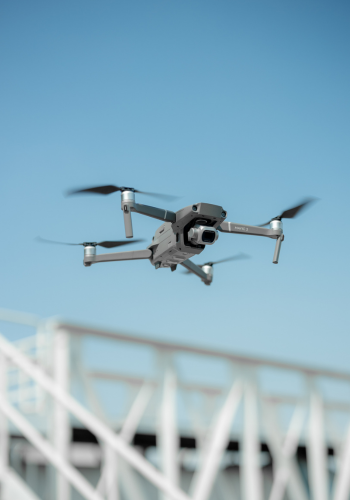
In an airport, security is not just about cameras and fences; airport security is a set of measures that incorporate patrol rounds, alerts, and rapid, error-free resolution of suspicious activity. In Bordeaux, this framework acts as a testbed for a broader European program also implemented in Nice, Lyon, and Basel-Mulhouse. It focuses on deploying AI-driven drones and ground robots using sovereign 5G imaging systems to identify anomalous or suspicious situations and transmit high-quality alerts to the command hub.
Bordeaux Airport has experimented 5G

Sector of activity
Airport security

Business needs
The Bordeaux airport is looking for a solution to detect a suspicious situation and then transmit an alert to the command center with the highest possible quality.

Solutions
Orange is supporting Bordeaux Airport alongside Optim.aize, which is responsible for orchestration and the digital twin security system, as well as drone manufacturer Lynxdrone.

Benefits of 5G
5G enables rapid mobilization at critical moments and allows adaptation to situational demands by integrating APIs for authentication, geolocation, and on-demand quality management.
Innovation in airport security: the synergy between drones, AI, 5G, and APIs for reliable alerts
In this program, Orange supports Bordeaux Airport alongside Optim.aize who is responsible for project orchestration and the cybersecurity digital twin, and drone manufacturer Lynxdrone. Orange’s contribution lies in a subtle yet crucial aspect: a 5G network capable of dynamic activation during critical moments and real-time adaptation to situational requirements. Authentication, geolocation, and on-demand quality management APIs enable the network to adjust in real time and ensure safety of one and all.
Repositioning humans where they matter most
The starting point is simple: in airports, security systems still rely heavily on repetitive, demanding tasks where fatigue eventually takes its toll on staff.
The limitation of the current system is that security officers repeat the same actions thousands of times a day. Inevitably, they experience fatigue and even a loss of purpose,” explains Jérôme Morandière, Head of Security at Bordeaux Airport.
In light of this reality, a transformation is gradually taking place. The approach consists in entrusting the first layers of detection to technology, and then involving humans where their value is highest: analysis, correlation, and decision-making.
We’re repositioning humans where they excel most — in tasks that call for natural intelligence” he explains.
For Jad Rouhana, CEO of drone manufacturer Lynxdrone, this shift is essential when managing complex sites.
In an autonomous system, we cannot rely solely on human intervention. Machines handle detection, but it’s people who validate, interpret, and make the final decisions.
In short, technology does not replace the operator; it gives them back time, autonomy, and greater decision-making capacity.
Producing fewer alerts, but better qualified ones
In the field, this new organization relies on unmanned autonomous vehicles (UAV) capable of generating a massive amount of information.
A drone can produce about 30 gigabytes of data per hour. Transmitting everything continuously is neither feasible nor useful», reminds Jad Rouhana. This is precisely where the network becomes strategic.
When the AI embedded in a drone detects an abnormal situation, it triggers a specific request to send a richer data stream, particularly in video, » explains Philippe Delbary, Head of Innovation Product at Orange. « The network then responds by guaranteeing the necessary bandwidth so that the operator can make the right decision.
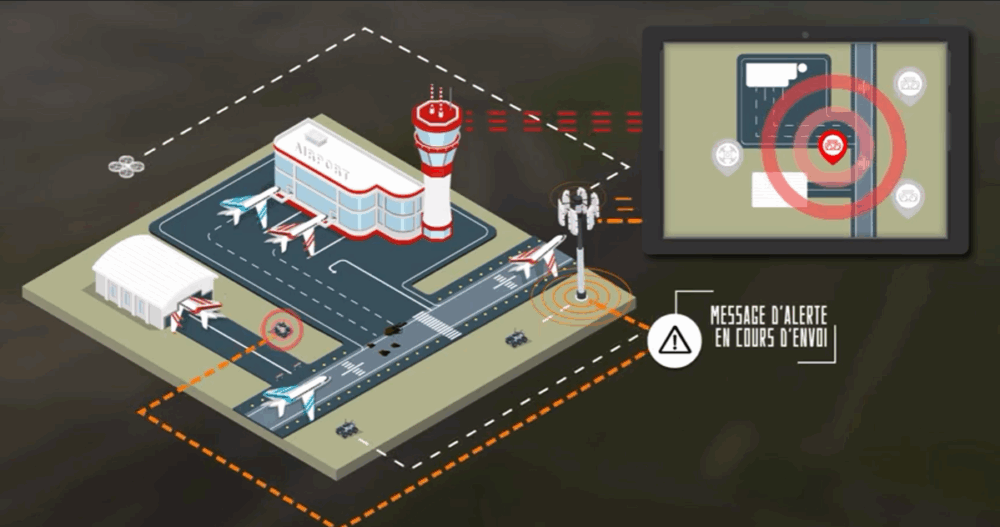
The network thus becomes a full-fledged player in the alert chain: it ensures the necessary bandwidth to enable reliable verification. In an airport environment, where a confirmed alert can lead to the closure of an area for several hours,
the quality of the video stream is crucial both to avoid false alarms and to confirm real situations,” explains Philippe Delbary. For drones, this capability is fundamental to the very existence of the system. “Without prioritizing the data streams, the solution simply cannot function,” summarizes Jad Rouhana.

The relevance of an alert also depends on how readable it is.
An raw alarm is useless if it is not contextualized,” recalls Sébastien Roche, CEO of Optim.aize, a specialist in industrial and geospatial data. His team is developing a security digital twin, a true digital envelope of the airport, in wich existing data and information reported autonomous vectors are aggregated. “We contextualize the vectors in real-time: immediate environment,” he explains. “Within this digital twin, we correlate alarms, video streams and geospatial information in order to provide an actionable view to the command center.”
The airport fully shares this requirement.
The key is to avoid overwhelming people with incomprehensible alerts,” stresses Jérôme Morandière. Because for the airport, the quality of information takes precedence over quantity. “If a sensor sends an alarm every minute, the operator can no longer make decisions. What matters is the quality of the information, not its volume.
When the network becomes a security tool
At the heart of this chain, the network also plays a security role. Concretely, the Orange API components make it possible to chain several security layers: authentication of the vector, geolocation, then activation of enhanced quality of service (or quality on demand).
When an alert is triggered, the operator starts by verifying the drone’s identity and location,” explains Philippe Delbary. “Only then is the video stream opened at maximum quality. We move from a passive network to a network that adapts to the business application,” he sums up. In other words, the application requests, and the network executes.
This double verification is a major issue:
We cross-check the information coming from the robot with that from Orange’s network to prevent any spoofing,” confirms Jad Rouhana.
Network-based geolocation provides an additional guarantee.
A GPS can be spoofed, but a network coordinate cannot,” points out Philippe Delbary


Experimenting, securing, industrialize
Orange 5G Lab facilitated the launch of the project by providing 5G routers, and the Orange Livenet team deployed an experimental 5G network for testing. If the technology is promising, its large-scale deployment must the comply with the stringent constraints of the aviation sector.
Airports have extremely high cybersecurity requirements, and we will not be exempt from the framework of the European AI Act” recalls Jérôme Morandière.
For Sébastien Roche, the key lies in gradual rollout: “We need to validate the sensors, measure false alarm rates and test multi-vector orchestration in real-life conditions.”
This initial experiment also paves the way for other use cases:
It works for security in sensitive areas (ports, industrial, military or government sites, etc.) but also for industrial maintenance, for example to inspect Orange pylons. Today, these missions are still carried out by human operators, sometimes at the cost of serious accidents,” explains Philippe Delbary
In Bordeaux, the airport experiment sketches out a concrete trajectory for the future of security: drones and AI on the front line, humans refocused on decision-making, and 5G that no longer merely connects, but becomes a true tool for securing and managing alerts.
Discover the live demo at MWC 2026 in Barcelona
Also worth discovering

Video Interview
Jérôme Morandière et Otilia Anton
Conference: ‘Innovating with Network APIs’
Aviation security is a major strategic challenge, facing regulatory, technological, and security-related obstacles. During the “Innovating with Network APIs” conference on November 20, 2025, held at Orange OpenTech 2025, Jérôme Morandière, Director of Security at Bordeaux, shared his insights, notably presenting the innovative Pandrone project.
Watch the video
Subscribe to our Orange 5G Lab newsletter