In Rennes, 5G serving more accessible urban mobility
Published on : 25/02/2026

5mn reading time
In the heart of Rennes, a shuttle circulating in the historic center becomes a true mobile laboratory. Thanks to onboard 5G technology, it allows testing new services to improve residents’ accessibility and mobility.
Crédits vidéo : Orange, Keolis
Keolis Rennes Métropole has experimented 5G

Sector of activity
Public Transportation

Business needs
Keolis Rennes aims to measure the ridership of a free shuttle and test an innovative mobility solution

Solutions
Orange 5G Lab proposes to connect the shuttle to 5G and provides a 5G router.

Benefits of 5G
Beyond simple connectivity, 5G offers the capacity to process large amounts of information and to provide new services to travelers.
Keolis Rennes Métropole is testing the connected 5G shuttle for a more accessible city
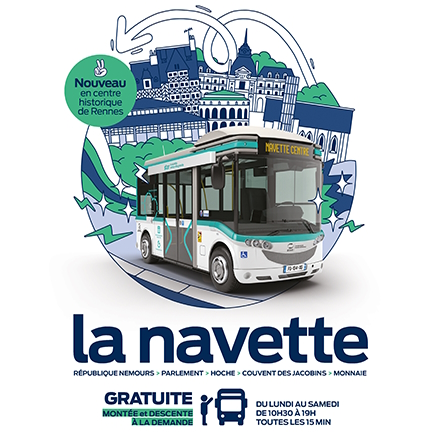
A shuttle dedicated to citizens
On the streets of Rennes, an electric shuttle runs daily for free, making a loop around the city center with thirteen stops. To better meet the needs of people with reduced mobility and seniors, it can even stop on demand between stops at any point along its route. Seemingly very simple, this device actually hides an unprecedented technological experiment:
The goal was to turn this shuttle into a real laboratory for new mobility solutions, since a shuttle that stops whenever you want is not very common!” explains Jean-Jacques Gaouyer, Innovation Director for Bretagne-Pays de Loire at Orange.
For Keolis Rennes Métropole, the operator responsible for transportation in the metropolis, the challenge was twofold: measure the usage of a free shuttle and test an innovative mobility system.
The starting point was the implementation of a new free shuttle in the hypercenter. However, without a ticketing system, it was difficult to track usage,” specifies Rodolphe Thyboyeau, Chief Information & Innovation Officer at Keolis. “The other difficulty was assessing the relevance of offering on-demand boarding and alighting.”
5G as an innovation lever
This is where 5G comes into play. By installing a 5G router capable of continuously transmitting data to the cloud, the shuttle becomes a true mobile sensor.
5G allows us to geolocate precisely and will enable in the future to count each boarding and alighting, as well as to monitor the shuttle’s occupancy in real time,” explains Jean-Jacques Gaouyer. All this information helps identify the most frequented zones and adjust routes or services based on usage patterns.
From the users’ perspective, the Star app turns the shuttle into an almost tailor-made service: on an interactive map, they can track the vehicle’s exact position in real time and plan their trips smoothly and securely within the city center.
Beyond geolocation, the technology enables more detailed analysis:
5G, beyond simple connectivity, offers the capacity to process large amounts of data and propose new services to travelers,” says Jean-Jacques Gaouyer.
It paves the way for future features such as reserving a seat for a wheelchair or stroller, reporting a full or nearly empty shuttle, and optimizing routes based on demand.
The goal was to create a mobility and technology lab with direct feedback for citizens,” summarizes Rodolphe Thyboyeau.
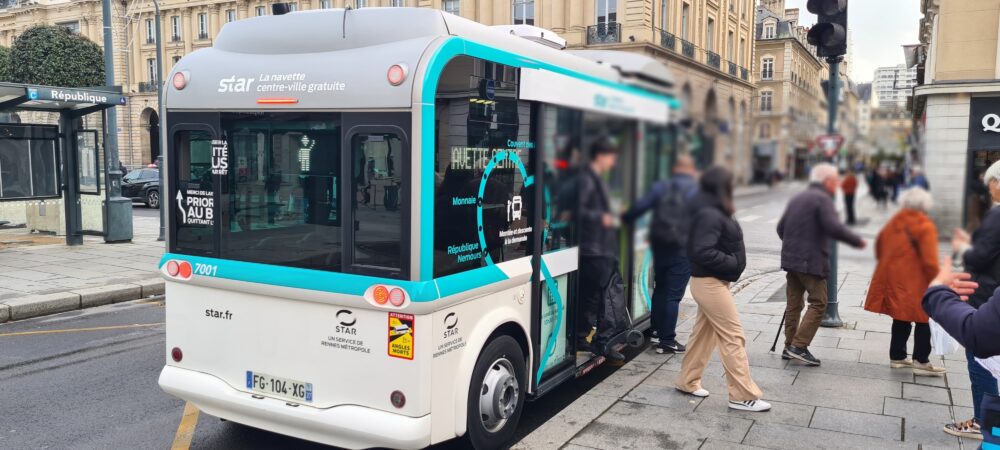
Accessible and inclusive mobility
Initial feedback confirms user interest.
Elderly or mobility-impaired people benefit most, but we also noticed increased attendance on rainy days or during tourist routes in the historic center,” observes Rodolphe Thyboyeau. The route passes by the Parliament, Saint-Pierre Cathedral, and the Jacobins Monastery, offering an almost involuntary guided tour. “It’s not his primary goal, but we realized that tourists were taking the opportunity to see the city from a different perspective!
Beyond the technological experiment, this shuttle illustrates Rennes’ commitment as a “city friendly to seniors
Initial feedback shows that the mere existence of the shuttle boosts usage and facilitates mobility for elderly or mobility-impaired people,” emphasizes Rodolphe Thyboyeau. The shuttle is not a gadget but a concrete tool to ease daily life and make the city more inclusive.
Future prospects
For Orange 5G Lab, the role was to support Keolis at each stage of the experiment: equipment installation, technical calibration, and monitoring real-world usage.
The advantage of working with the 5G Lab is its ability to support projects in an agile and cost-effective manner. If we need to experiment or test things, we can do it,” details Rodolphe Thyboyeau.
Our strength is transforming a pilot project into an operational solution, with the possibility to replicate the model on other lines or in other cities,” adds Jean-Jacques Gaouyer.
Beyond Rennes, the project demonstrates how 5G can transform urban mobility and enhance citizens’ experience. From precise geolocation to the potential addition of new services, this mobile laboratory paves the way for other initiatives, positioning Rennes as an innovation hub for smart and inclusive cities of tomorrow.
“It’s the perfect example of technology directly serving citizens,” summarizes Jean-Jacques Gaouyer. For Keolis, it also opens new perspectives: improving network management, anticipating needs, testing new usages, and possibly duplicating the model. By combining 5G technology and urban mobility, Rennes and Keolis show that innovation comes alive in the streets, serving citizens, and shaping the intelligent transports of tomorrow today.
To go further
• Smart City – how will 5G make our cities even smarter?“
• Article : “5G and innovation are making cities smarter and more resilient“

Subscribe to our Orange 5G Lab newsletter