MWC 2026 — Special Report: Challenges and Breakthroughs Shaping the Telecom Industry in the Era of Intelligent Connectivity
Date
Formats
Categories
Content
Published: 30/03/2026

18 mn time reading
The Mobile World Congress 2026 underscored a major shift in the telecoms sector. Networks are no longer just a connectivity infrastructure; they are increasingly becoming an orchestration platform for artificial intelligence, critical uses, and digital sovereignty.
With nearly 110,000 participants from more than 200 countries, the 2026 edition celebrated 20 years of the trade show in Barcelona, under the theme “The IQ Era” (integration of AI into the network). At the heart of the discussions were: standalone 5G, “native” AI in networks, satellite–terrestrial convergence, edge computing, security, and sovereignty.
For companies, the question is no longer whether these technologies will be ready. They already are. The real question now is: how to turn them into tangible business value, today.
Explore our report structured around two complementary perspectives:
I. What Orange showcased at MWC 2026: network–AI use cases that are already in production or close to market, and directly applicable to B2B contexts.
II. What MWC 2026 reveals about the telecom market: the major underlying trends (native AI, 5G SA, APIs, edge, satellites, security) that will shape your upcoming projects.
I. What Orange showcased: intelligent networks serving operations, communities, and trust
In line with its strategic plan “Trust the Future”, Orange made its stand a showcase for intelligent, resilient, and sovereign networks, organized around two key themes: “Reinvent Connectivity” and “Go Beyond Connectivity.” The objective: to show that 5G, advanced 5G, and AI are already creating business value.
I.1. Putting AI at the heart of the mobile network to empower field teams.
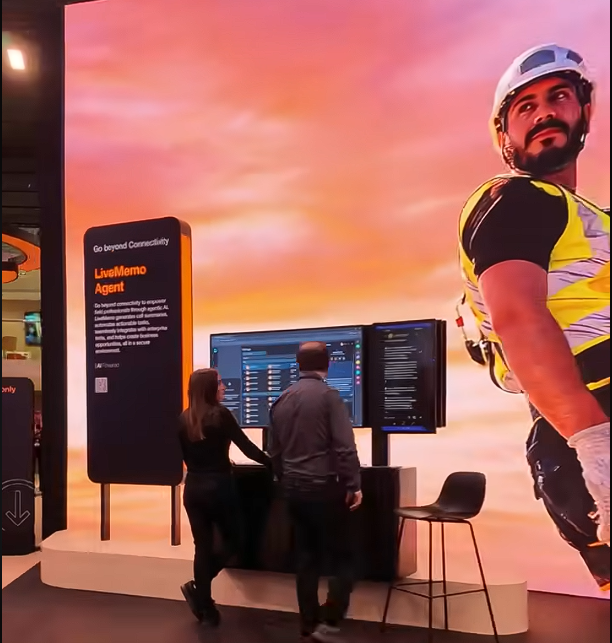
LiveMemo Agent: every call becomes a business action.
LiveMemo Agent is an embedded solution at the heart of Orange’s mobile network, with no app required on the smartphone. As an example of a new service that goes beyond simple connectivity, it combines:
- a trusted generative AI, secured by the Orange network;
- an “agentic” AI designed to interact with the company’s CRM software.
Together with its partner Ringover, a specialist in next‑generation customer experience, Orange demonstrated how LiveMemo:
- automatically generates call summaries;
- suggests action lists;
- updates customer records and opportunities in the CRM (notably Salesforce) with a single click.
💡 For sales teams, technicians, or customer service centers, the impact is immediate: less manual data entry, better traceability, consistent reporting, increased productivity, and a smoother customer experience.
I.2. Monitoring and protecting critical sites with network APIs, 5G, and digital twins
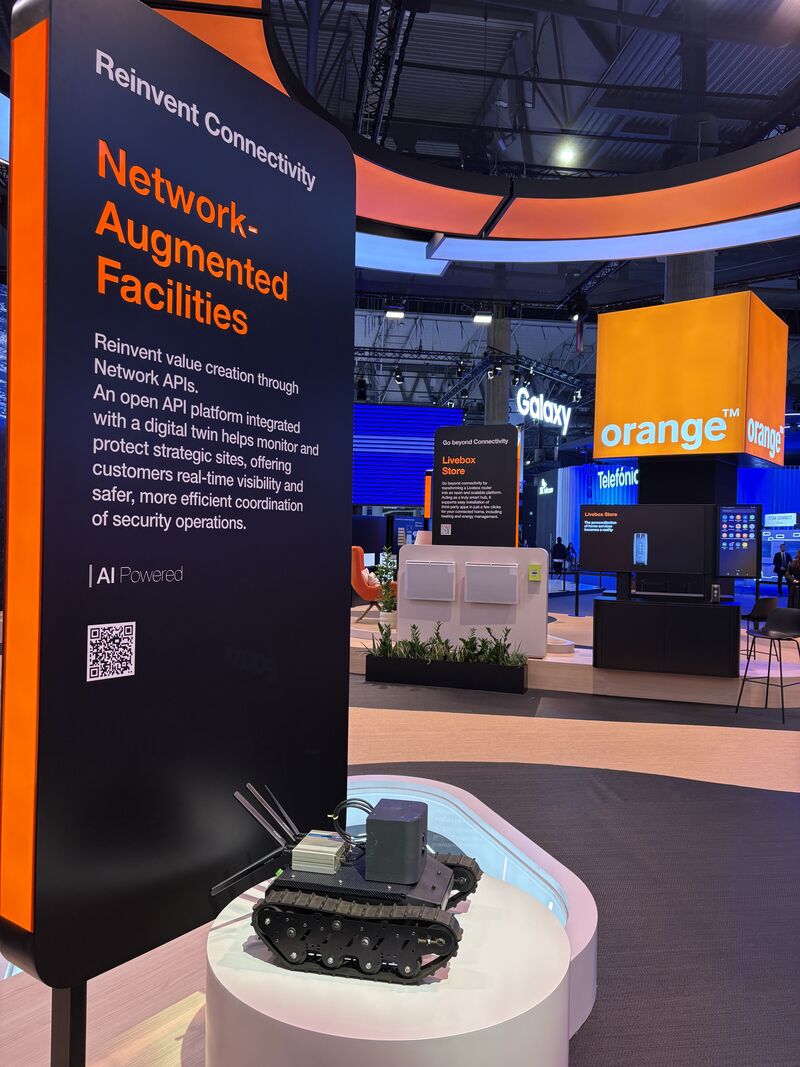
Network‑Augmented Facilities : the network as a safety tool
With Network Augmented Facilities, one of the demos illustrating the “Reinvent Connectivity” theme, Orange demonstrates how a network API platform integrated with a digital twin can secure strategic sites such as airports, industrial facilities, and energy infrastructures.
Scenario showcased in Barcelona:
- a 5G surveillance drone detects suspicious behavior at an airport;
- identity, anti‑fraud, and geolocation APIs authenticate the drone and confirm its position;
- from the digital twin, the command center triggers a 4K video stream;
- a Quality‑on‑Demand API dynamically adjusts the QoS to ensure a smooth stream;
- the intervention is coordinated end‑to‑end until the intrusion is neutralized.
This use case relies on an ecosystem of sovereign partners:
- optim.aize, for the aggregation of scientific, AI, and GIS (Geographic Information System) data within the Yaaps decision‑support platform;
- Lynxdrone, for rolling, flying, and floating drones;
- Shabodi, for the Network‑as‑a‑Service layer and network APIs.
💡 For businesses, the challenge is clear: to turn the network into a real‑time safety and monitoring tool capable of:
- combining sensor, video, and network data streams;
- triggering operational actions;
- providing contractual performance guarantees through APIs.
Orange Drone Inspection: safer and faster maintenance
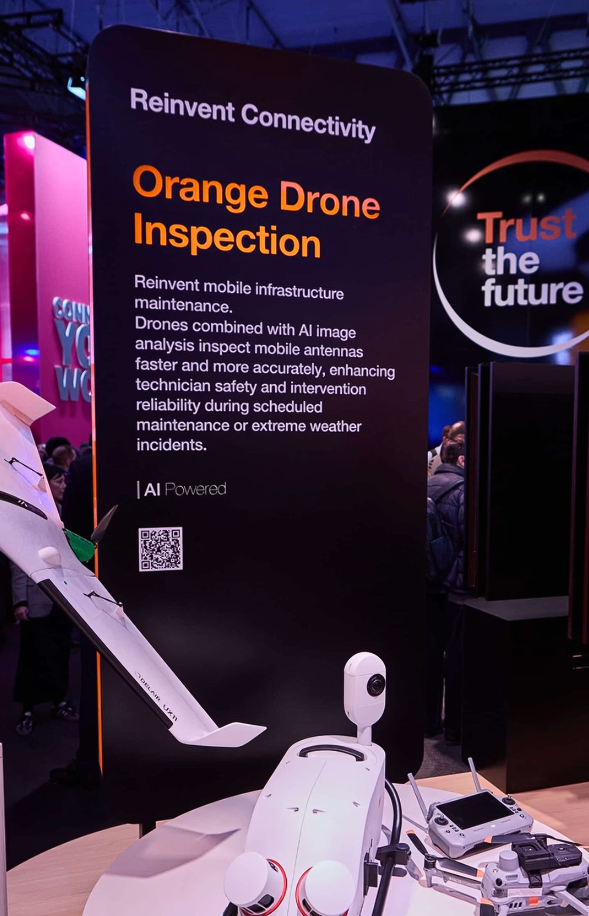
Another flagship demonstration: Orange Drone Inspection. Orange deployed a mobile BTS, or GSM base station, at its Orange Gardens site near Paris to stage a live antenna inspection from Barcelona.
On demonstration :
- a drone equipped with an Orange SIM card inspects an antenna in France;
- the video feed is transmitted almost in real time, via 4G/5G, to the exhibition stand;
- an AI platform automates image analysis to detect anomalies;
- a VR simulator lets visitors experience the operator’s perspective.
💡 Applied to other sectors (energy, transport, industry), this model shows how 5G + AI can industrialize asset inspection and predictive maintenance.
I.3. Fiber as the “nervous system” of territories
Fiber Detection: turning fiber into a sensor network
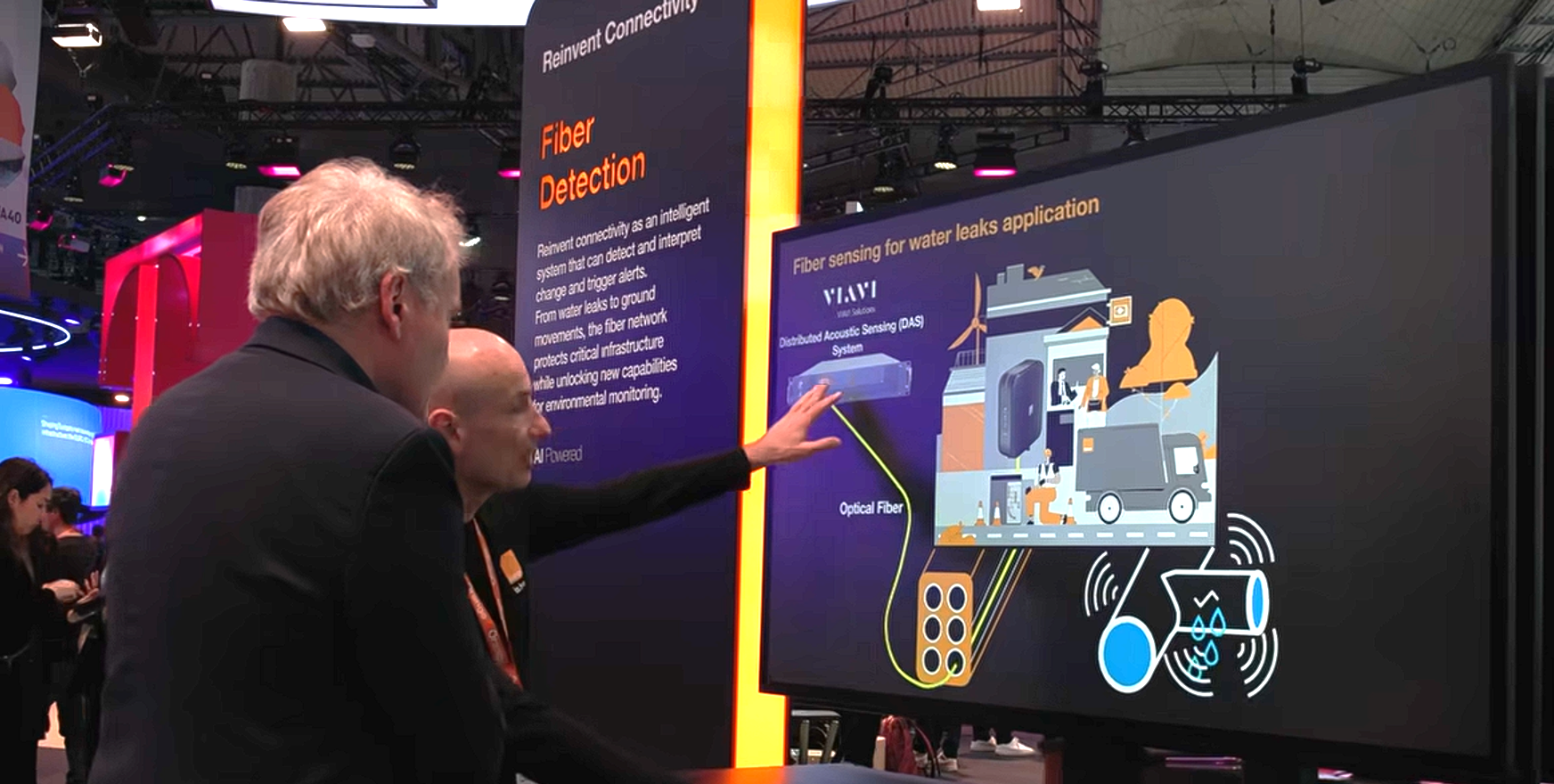
With Fiber Detection, Orange illustrates a key shift: using the existing fiber network as a sensor network for infrastructure monitoring.
The solution combines:
- Distributed Acoustic Sensing (DAS) technology from VIAVI, which measures variations in the optical signal to precisely locate disruptions;
- LightSonic’s AI algorithms to detect events (water leaks, vibrations, ground movements);
- Orange’s data processing and AI filters, operating in a secure, non-intrusive environment with full traceability of detection criteria.
On the booth, the demo is intentionally simple and concrete:
- walk or jump on a fibered area;
- tap on a technical cabinet;
- watch the event being detected, located, and instantly displayed on a dashboard.
Immediate use cases:
- detection of water leaks on buried networks;
- monitoring of ground movements to prevent collapses;
- protection of sensitive infrastructures in urban areas.
💡 This “network-as-a-sensor” demo offers new B2B growth opportunities without deploying new infrastructures or additional cables. For water operators, local authorities, or infrastructure managers, it provides a direct way to monetize existing assets.
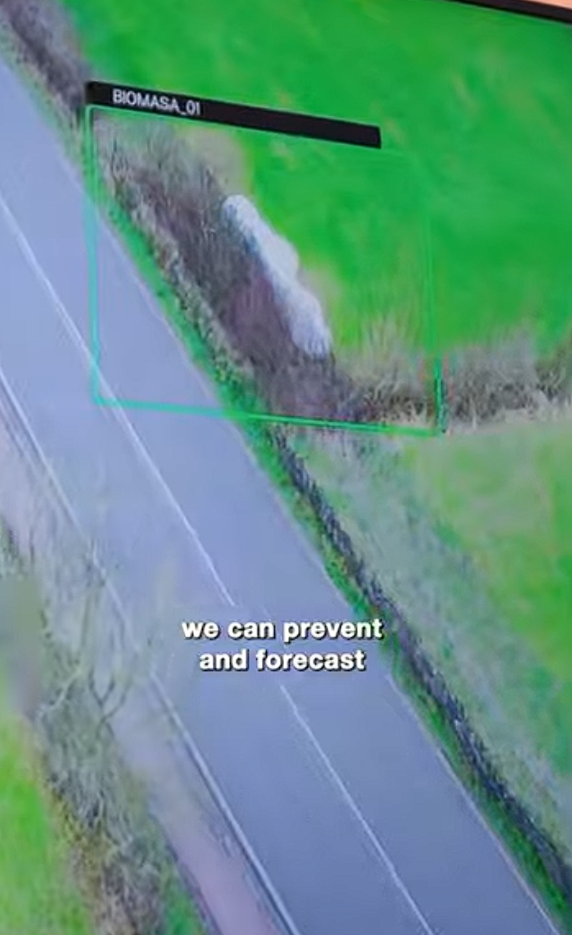
Forest Smart Guardian: smart monitoring to prevent forest fires
Along the same lines, Forest Smart Guardian shows how to combine:
- ground sensor data;
- images from autonomous drones;
- weather data;
- mapping and the network’s and AI’s analytical capabilities;
to detect fires at an early stage and produce risk maps.
For local territories, the benefit is twofold:
- improving prevention and operational response;
- protecting economic activities, infrastructures, and populations in exposed areas.
💡 Once again, the network is no longer limited to transporting data — it becomes a tool for territorial resilience.
I.4. From the Livebox to the enhanced home: a router that becomes a platform
Livebox Store: the box as a service platform for energy
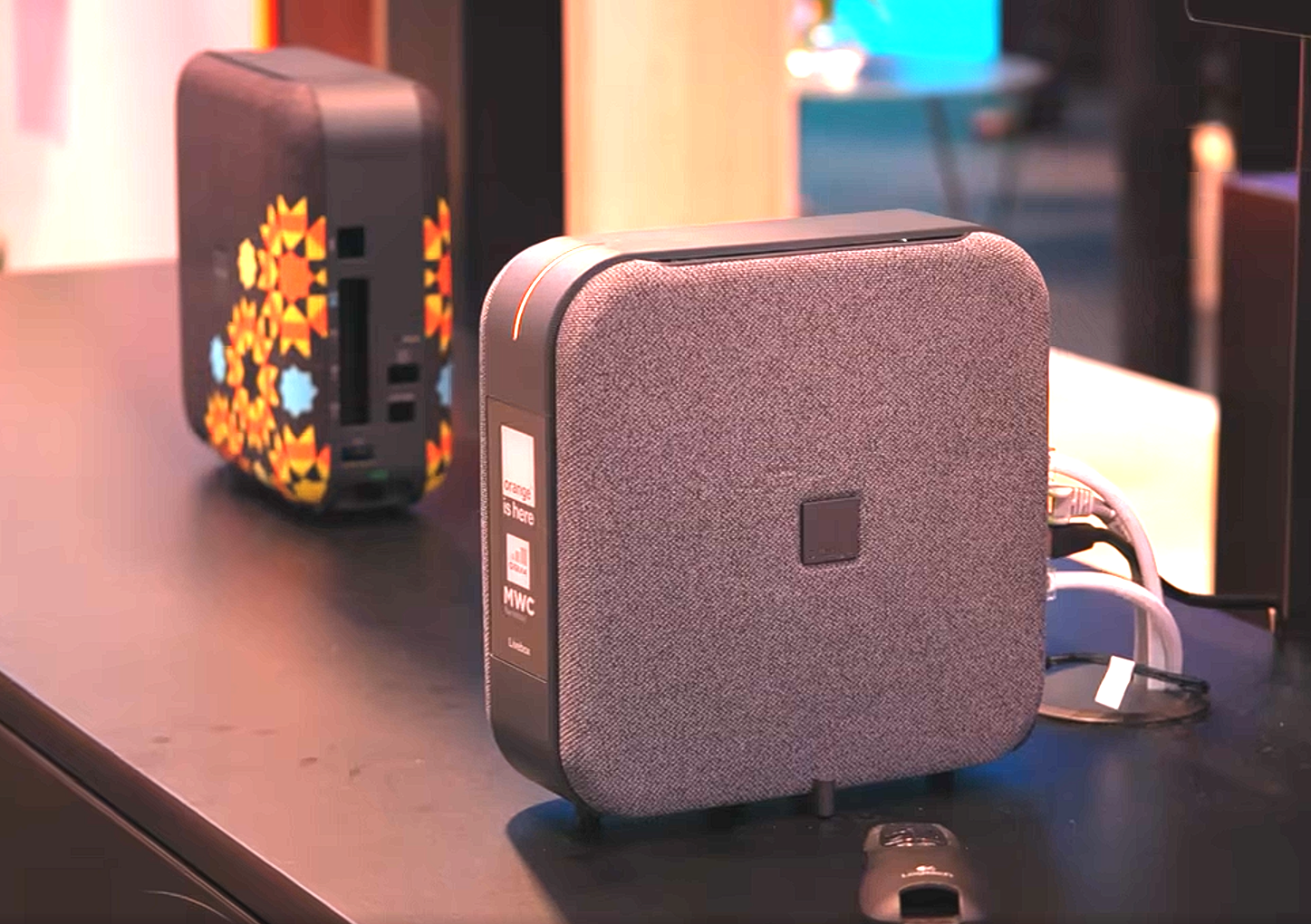
Under the “Go Beyond Connectivity” theme, Orange highlighted Livebox Store, an application marketplace integrated directly into the Livebox.
What’s new:
- the Livebox, thanks to the prpl OS and local APIs, becomes an open platform for smart orchestration;
- third-party services (energy management, home security, cybersecurity, etc.) can be installed and managed directly from the Livebox.
Together with EDF R&D, Orange showcased a concrete use case:
- a customer equipped with a prpl‑compatible Livebox and a Linky smart meter connected via Wi‑Fi;
- installation of an energy management service in just a few clicks through the Livebox Store;
- monitoring consumption, controlling radiators, and optimizing energy usage.
💡 For players in the energy, building, home automation, or insurance sectors, this approach opens a direct channel to the home, based on equipment that is already deployed, programmable, and secure.
Family Protection: combining AI, cybersecurity, and sociology to support families
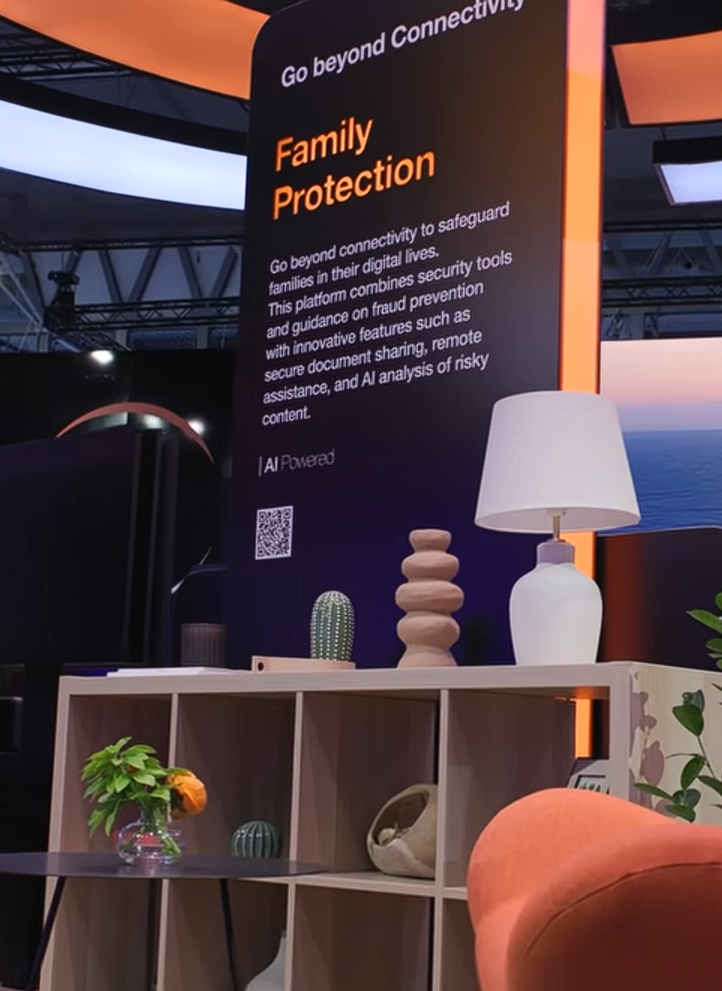
Another demonstration from Orange’s in‑house Research teams: Family Protection, the first platform that combines AI, cybersecurity, and family support to advise and protect household members against:
- suspicious messages;
- phishing attempts;
- risky content.
💡 For a B2B audience, it showcases expertise in trustworthy AI and user-centered design, which can be applied to cybersecurity solutions for professionals, education, or small organizations.
I.5. Network APIs, AI, and sovereignty: the common building blocks behind these use cases
Network APIs & Agentic AI: “There’s no AI without APIs”
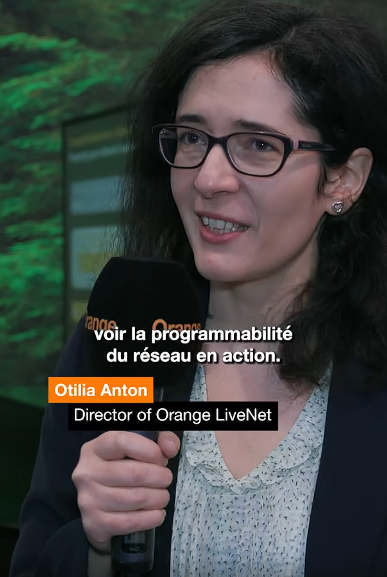
Otilia Anton, Director of Orange LiveNet, sums up the link between programmable networks and AI well: “in fact, there’s no AI without APIs.”
At the booth:
- The LiveMemo, Network-Augmented Facilities et Branded Calling demos illustrate how network APIs (voice, identity, anti‑fraud, QoS, location, etc.) give the network an active role in security, trust, real‑time visibility, and the automation of business processes.
- AI agents use these APIs to authenticate, execute workflows, adjust service quality, and orchestrate resources.
This vision aligns with the GSMA Open Gateway / CAMARA movement, which the GSMA presents as one of its top priorities for 2026: the widespread adoption of identity APIs, and the rollout of network performance, location, and edge computing APIs.
💡 For businesses, the challenge is clear: in the long run, their business applications will be able to communicate directly with the network to request:
- specific quality of service for a critical data flow;
- identity verification based on the SIM;
- reliable location of a device or vehicle.
Trustworthy AI and sovereignty: pivoting toward “Trust the Future”
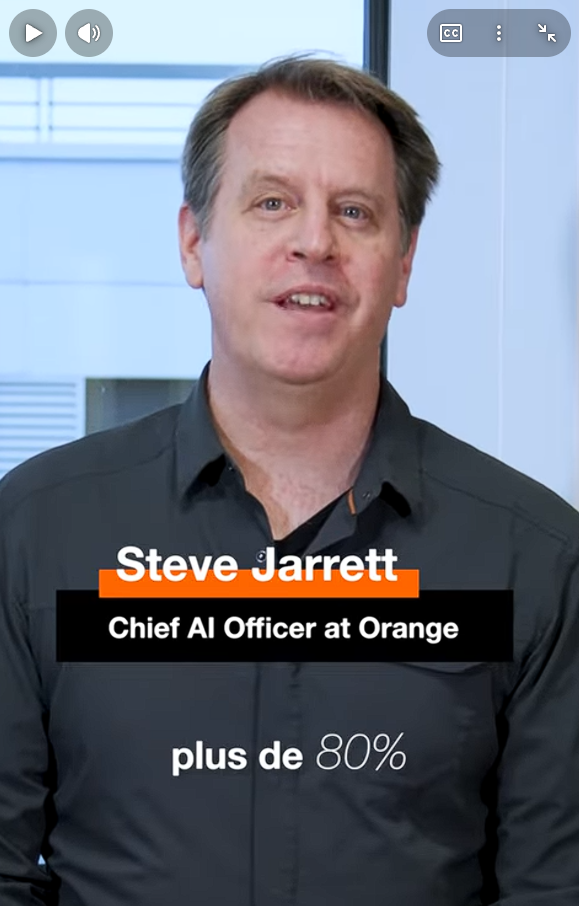
Steve Jarrett, Chief AI Officer d’Orange, points out that:
- More than 100,000 Orange employees — over 80% of the workforce — already use the internal AI platform, Live Intelligence;
- This solution is now being offered to B2B customers;
- Innovations such as Max it Easy Talk include African languages (Bambara, Wolof, Lingala, etc.) to make digital services accessible to audiences with low literacy levels.

Lyse Brillouet, Executive Vice-President Research Orange,
on her side, points out that:
- Orange ranks 9th in the INPI France ranking ;
- 80% of new inventions incorporate AI;
- 44% of patents concern future networks, 38% AI, and 22% cybersecurity.
This positioning directly responds to the rise in demands for sovereign AI, cybersecurity, and data control, which are particularly strong in Europe and Africa.
💡 For a company, this means having a partner capable of providing “telco-grade(1)” AI and network solutions, backed by controlled infrastructures and trusted frameworks.
II. What MWC 2026 Reveals About the Market: Toward AI‑Native, Autonomous, and Multi‑Orbit Networks (Terrestrial + Satellite)
Beyond Orange’s demonstrations, MWC 2026 sends clear signals about the industry’s trajectory. For B2B decision makers, these trends will shape the choices to be made over the next three to five years.
II.1. AI Becomes the “Operating System” of Networks
Fierce Network summarizes the evolution observed in Barcelona as follows: AI is shifting from network monitoring to serving as the actual “operating system.” It no longer just monitors — it now:
- optimizes the RAN;
- adjusts routing;
- detects and diagnoses faults across multi‑vendor environments.
For example, several companies at the event have already deployed large‑scale platforms in this direction:
- Lumen Technologies uses Blue Planet AI Studio (Ciena) to develop its own AI agents integrated into OSS workflows, paving the way for closed‑loop operations and more autonomous networks.
- Deutsche Telekom and Google Cloud are developing MINDR, a multi‑agent platform designed to proactively diagnose and resolve network incidents, as an extension of the RAN Guardian system.
💡 For businesses, the impact is straightforward: networks that are more predictive, self‑optimizing, and able to self‑correct faster. In practice, this means greater reliability for critical applications such as industry, healthcare, mobility, and logistics.
II.2. 5G SA and 5G‑Advanced: An Essential Step Toward AI‑Native 6G
Ericsson, in its pre‑MWC briefing, positions 5G standalone (SA) as the commercial and architectural bridge toward an AI native 6G.
Key reasons:
- The upcoming explosion of uplink traffic driven by AI glasses, robots, and humanoids;
- The rise of latency as a key commercial parameter;
- The need for network slicing and guaranteed QoS to differentiate service offerings.
Omdia notes that by the end of 2025, only 77 operators had launched 5G SA networks, compared with 253 5G networks in total. According to Vivek Badrinath, CEO of GSMA, there is urgency — as he stated in his opening keynote: “First of all, we must complete the 5G journey.”. Indeed, most operators have yet to make this transition, even though it is a prerequisite for monetizing:
- network APIs,
- private networks,
- edge computing,
- advanced slicing.
💡 Today, only 5G can combine high throughput, ultra‑low latency, and strong reliability for use cases such as autonomous vehicles or industrial robots. For an industrial player, the effective availability of 5G SA in its region is therefore becoming a decisive factor in determining feasibility.
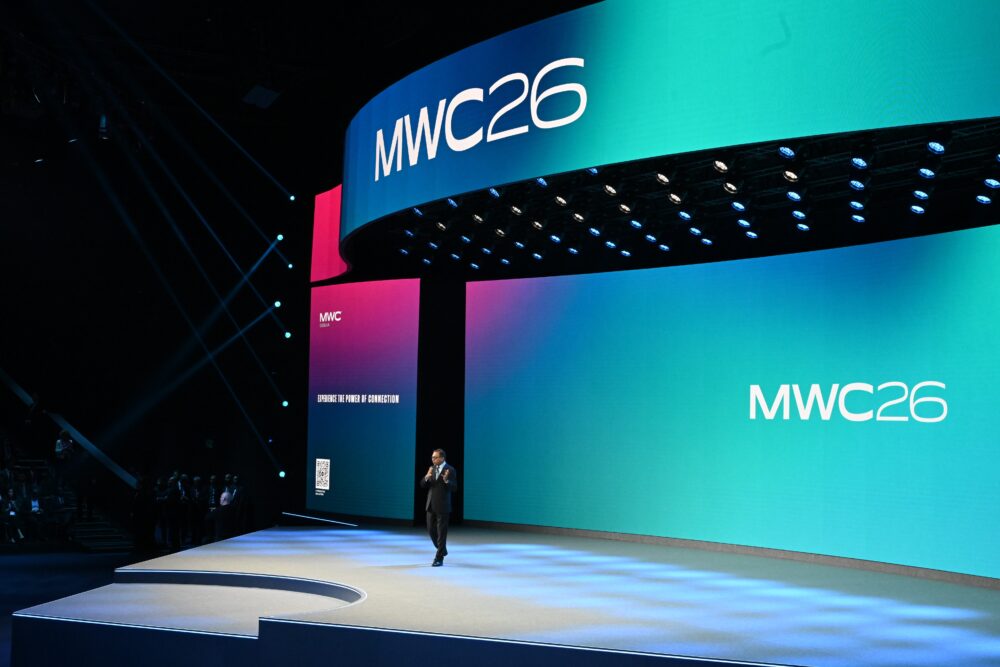
Above all, we must successfully carry out the transition to 5G. 5G represents the modernization of society itself. In a future where cities will think for themselves, factories will operate autonomously, and robots will be part of everyday life, it is essential to invest in standalone 5G. Countries that hesitate will fall behind. You can clearly see here the competitive advantage that comes from investing in standalone 5G. In markets where adoption rates reach at least 10%, operators experience revenue growth twice as fast as those who have not adopted it. And standalone 5G could generate up to 1,078.7 billion dollars in mobile revenues by 2030. (…) We must recognize the urgency. If we want to unlock the full potential of 5G and lay solid foundations for a future 6G, we must first and foremost complete the transition to standalone 5G (4)
Vivek Badrinath
II.3. Network APIs and NaaS: Connectivity Becomes Programmable
The year 2026 marks the acceleration of identity, location, and network performance APIs, as illustrated by several concrete examples seen in Barcelona:
- Ericsson + Toyota + AECC : : “Quality on Demand” APIs and edge APIs for remote driving and in‑car infotainment.
- Google Cloud + Glide Identity : MagicalAuth, a SIM‑based identity verification solution, currently in beta with Verizon and T‑Mobile US.
- Orange + Shabodi : An API‑driven NaaS (Network‑as‑a‑Service) solution for B2B applications, notably showcased through Network‑Augmented Facilities.
💡 For businesses, this outlines a future where:
- a logistics system can request enhanced QoS via an API for a critical route;
- a banking application can verify a user’s identity by relying on the SIM and the network;
- an IoT solution can automatically adapt connectivity based on the context.
II.4. Edge Computing and “Physical AI”: Bringing Intelligence Closer to Machines
Computer vision is currently the main driver of edge AI, representing nearly 50% of the edge AI market by 2025 according to STL Partners. Physical AI — encompassing robots, vehicles, drones, and autonomous machines — requires local processing, close to the RAN, in order to coordinate, reduce latency, and ensure security
Whether it involves agents, robotics, vision systems, or real time assistance, all these use cases — widely demonstrated during the event — demand processing as close to the field as possible. The numerous demonstrations, including the massive presence of robots, reinforced the idea that connectivity, edge AI, and the control of physical agents now form part of a single continuum.

On the operators’ side, several initiatives are reinforcing this trend:
- Singtel, China Telecom, and others are building AI factories coupled with network edge sites for inference..
- In Europe, the European Edge Continuum initiative and the EURO3C project aim to federate the edge infrastructures of multiple operators (Orange, Deutsche Telekom, Telefónica, TIM, Vodafone, BT, KPN, OVHcloud, and others) to provide a continuum of sovereign services.
Orange’s Fiber Detection, Drone Inspection, and Network‑Augmented Facilities demos are directly aligned with this trend: bringing AI as close to the field as possible — on or near the network itself.
II.5. Satellites and Multi Orbit: Toward Truly “Everywhere” Connectivity
Satellite connectivity and Direct‑to‑Device (D2D) services took on a new importance at MWC 2026, as shown by several key developments:
- The rise of Starlink Mobile, which rebranded its D2D offer and is preparing a V2 generation of satellites capable of delivering mobile speeds of up to 150 Mbit/s, with launches expected to begin in 2027.
- The emergence of players such as AST SpaceMobile, Lynk Global, Amazon Leo, which are multiplying partnerships with operators including T‑Mobile US, KDDI, Telus, Deutsche Telekom, and Vodafone.
Orange announced a partnership(2) with AST SpaceMobile and Satellite Connect Europe (the AST/Vodafone joint venture) for Direct‑to‑Device demonstrations in Romania — covering voice, SMS, and data — and the addition of AST to its satellite portfolio, which already includes Eutelsat, SES, and Starlink.
💡 The message is clear: satellite connectivity is not a substitute but a complement to terrestrial networks, designed to:
- cover areas where terrestrial deployment is too costly or impractical;
- ensure resilience in the event of disasters or crises;
- enable new services across the energy, transport, maritime, aviation, and emergency response sectors.
II.6. Security, Identity, and Trusted AI: Foundations of Value
The figures are striking: according to Cybersecurity Ventures, which estimates the global cost of cybercrime at 10.5 trillion USD per year, that figure — growing at an estimated rate of 15% annually — could reach 15.6 trillion USD by 2029, up from 9.2 trillion USD in 2024.
At the MWC, we saw operators positioning themselves as active defenders of the digital space, rather than merely as simple connectivity providers.
Examples:
- Airtel, Deutsche Telekom, LG Uplus, SK Telecom : voice/SMS scam detection, filtering of suspicious URLs, network-level detection of audio deepfakes, and voice assistants with built-in anti‑fraud alerts.
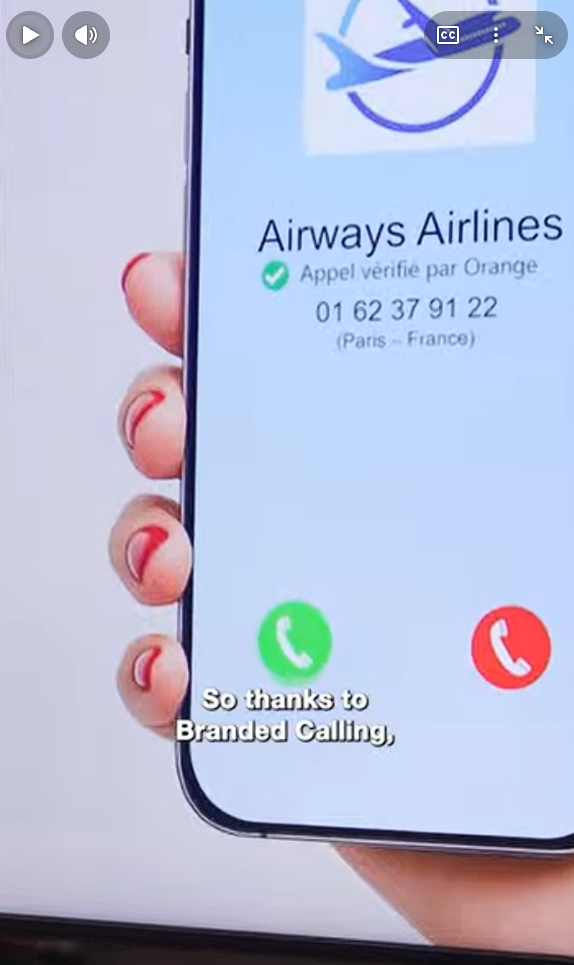
- Orange’s Branded Calling: displays the verified brand name of the calling company on the smartphone screen to increase trust and conversion rates. The service will be available for all calls to Orange mobile users in France during 2026.
In this context, AI plays a dual role:
- as a weapon for fraudsters (more sophisticated scams, convincing deepfakes);
- and as a defense tool for operators (proactive detection, filtering, and stronger digital identity).
💡 For businesses, this means that the value created by 5G, AI, and network APIs is inseparable from operators’ ability to deliver security, identity, and compliance services that are natively integrated into the network.
Conclusion: networks are becoming the operational infrastructure of the AI economy.
The 2026 MWC showed that telecom players are determined to become the reference infrastructure for the AI economy. Figures from GSMA(3) highlight this: $7.6 trillion in economic value generated by mobile in 2025, and $11.3 trillion expected by 2030 — representing 8.4% of global GDP.
This transformation is clearly visible at the Orange booth:
- mobile and fixed networks that self‑optimize and host AI agents for customer relations (LiveMemo) ;
- infrastructures turned into safety systems for critical sites (Network‑Augmented Facilities, Drone Inspection) ;
- fiber becoming a sensing network for water, soil, and cities (Fiber Detection) ;
- territorial resilience solutions (Forest Smart Guardian) ;
- a Livebox transformed into a service platform for energy management and the connected home (Livebox Store) ;
- offers built around trust (Family Protection, Branded Calling, Network APIs d’identité et de sécurité.)
For businesses, these innovations are no longer distant concepts.
They are immediate levers to:
- secure and monitor sites and infrastructures;
- accelerate and improve maintenance reliability;
- transform customer relations;
- optimize energy consumption;
- strengthen operational resilience through multi‑orbit connectivity;
- integrate security and digital identity at the core of processes.
The next step is not technological — it is organizational and strategic: identifying, sector by sector, the use cases where 5G SA, AI, and network APIs can create the most value, and testing them in suitable experimental environments..
This is precisely the role of Orange 5G Lab: to enable companies, local authorities, and partners to co‑develop these use cases, validate them in real‑world conditions, and move from proof of concept to operational deployment.
Discover and experiment 5G+ with Orange 5G Lab
Orange 5G Lab, with 22 sites in France and abroad, supports all companies eager to experiment with 5G and fully harness its potential.
Through concrete and innovative solutions, we help them transform their businesses and anticipate tomorrow’s challenges.
Make an appointment with an Orange 5G Lab expert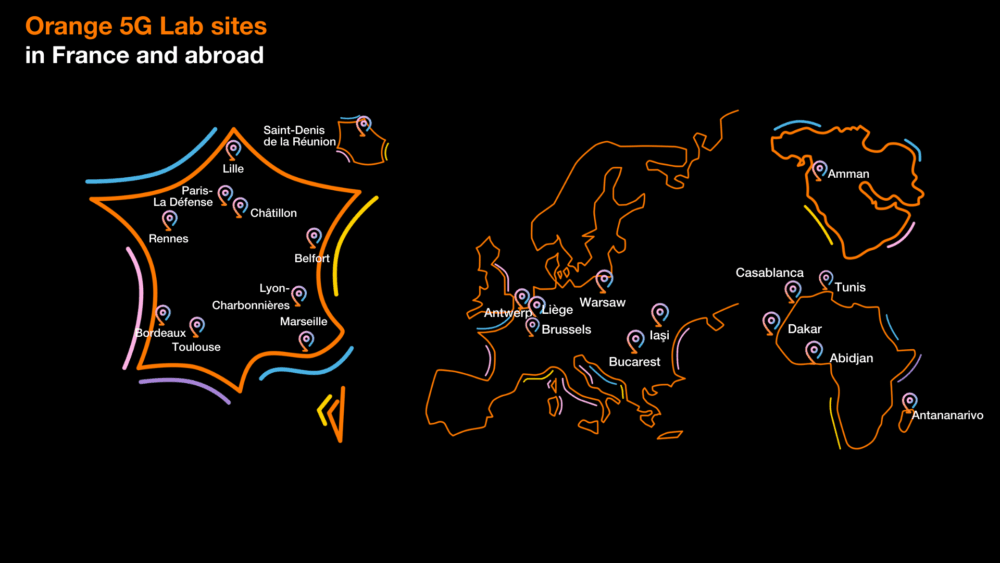
Learn more about MWC 2026
Use case on airport security and Network APIs
Discover content on Hello Future
- At MWC, Orange’s AI Brings Networks to Life for Users
- AI Agents: Toward Orchestrated Autonomy and Human-Machine Co-Intelligence
- Fiber Detection: Orange Networks to Detect and Analyze Water Leaks
- Edge Federation: The Sovereign and Resilient Operator Alternative for AI Infrastructure in Europe
Orange booth videos
- MWC Livebox Store – with Frédéric Le Mounier, Chief Product Officer at Orange
- MWC Family Protection – with Lyse Brillouet, Executive Vice-President Research Orange
- Steve Jarrett, Chief AI Officer at Orange, showcases trustworthy AI and the Live Intelligence offering
- Strategy – Bruno Zerbib, CTIO Orange, talks with analyst Carolina Milanesi
- Networks and smart connectivity – with Laurent Leboucher, Group CTO, EVT Networks at Orange
- API – with Otilia Anton, Orange LiveNet Director
- Devices trends– with Philippe Lucas, EVP Partnerships Content and Devices at Orange
- MWC LiveSpace – with Jessy Asmar, Head of Satellite Factory, Orange Wholesale
- MWC Mobile Telco as a Service – with Anass Sadoun, 5G Products Manager, Orange Wholesale
References
- (1) « telco-grade » : AI and connectivity solutions that meet industrialisation, reliability, security and scalability standards derived from the operator world.
- (2) https://www.orange.com/fr/communiques/orange-sassocie-a-ast-spacemobile-et-satellite-connect-europepour-la-connectivite-satellite-direct-to-device-d2d-avec-des-premiers-tests-en-roumanie-441758
- (3) https://www.gsma.com/solutions-and-impact/connectivity-for-good/mobile-economy/
- (4) https://www.mwcbarcelona.com/agenda/sessions/6088-keynote-1-leading-the-future-intelligent-inclusive-unstoppable
- https://newsroom.orange.com/download?n=MWC20268_Descriptifs%20des%20de%CC%81mos_VF&picid=62111
- https://www.orange.com/fr/communiques/mobile-world-congress-2026-orange-met-en-scene-lintelligence-et-la-resilience-de-ses-reseaux-441446
- https://hellofuture.prp.cops-gcp.multimediabs.com/fr/fiber-detection-la-fibre-dorange-qui-detecte-et-analyse-les-fuites-deau/
- https://www.linkedin.com/posts/orange-business_otilia-anton-director-of-orange-livenet-activity-7435595030519779328-1r19?utm_source=share&utm_medium=member_desktop&rcm=ACoAAABc_YUB51prBxwSM5PSCPwpWBp4zZ-scKM
- https://hellofuture.prp.cops-gcp.multimediabs.com/fr/orange-ameliore-le-taux-de-decroche-en-certifiant-lidentite-de-lentreprise-appelante/
- mastermedia.orange.com/publicMedia?t=pmR4aRt8JF
- mastermedia.orange.com/publicMedia?t=pmAI5Fy9IS
- https://www.gsmaintelligence.com/research/5g-and-network-transformation-five-trends-to-watch-in-2026
- https://www.fierce-network.com/wireless/mwc-2026-5-takeaways-telecom-industry
- https://omdia.tech.informa.com/om144031/ericsson-highlights-5g-sa-as-a-critical-bridge-to-ai-native-6g-at-its-pre-mwc-2026-event#:~:text=Summary,and%20prepare%20networks%20with%20AI.
- https://stlpartners.com/research/edge-ai-market-forecast-computer-vision-leads-the-way/
- https://www.mobileworldlive.com/french/de-grands-operateurs-mettent-leuropean-edge-continuum-en-vedette-au-mwc26/
- https://www.telecomtv.com/content/access-evolution/mwc26-starlink-preps-new-d2d-constellation-54977/
- https://digital-strategy.ec.europa.eu/fr/news/commission-announces-eu75-million-euro-3c-project-build-federated-telco-edge-cloud-infrastructure
- https://www.esentire.com/resources/library/2023-official-cybercrime-report
Subscribe to our Orange 5G Lab newsletter