Leveraging 5G: Insights and Opportunities for Businesses
Date
Formats
Categories
Content
TAG (S)
Published : 03/03/2026

3mn reading time
Discover how 5G can transform your business model and drive innovation within your company
5G is much more than just a technological upgrade; it represents a real revolution for businesses, whether they are B2B or B2C oriented. With connection speeds up to 100 times faster than 4G, latency reduced to a few tens of milliseconds, and higher connection density allowing a large number of devices to be managed simultaneously, 5G paves the way for unprecedented opportunities for innovation. According to data from GSMA Intelligence(1), the number of 5G connections is expected to reach 5.6 billion by 2030. In this article, discover key insights that can help businesses leverage this technology to innovate and stand out in the market.
A growing interest in 5G among end consumers
39% of non-5G(2) users considering switching to this new technology
5G adoption is booming, with nearly 39% of non-5G(2) users considering switching to this new technology. This trend is particularly pronounced in markets such as China and the UAE, where consumers are showing increased interest in 5G services (up to 78%). In fact, 84%(2) of 5G users say they are satisfied with their experience, inclunding 87% in France, highlighting the added value this technology can offer. For businesses, this represents an opportunity to attract new customers by offering enhanced and innovative services tailored to the expectations of modern consumers.
A wide range of attractive use cases
68% (2) of consumers find 5G use cases particularly attractive
The use cases for 5G are numerous and varied, ranging from telehealth applications to augmented reality solutions. According to studies, 68%(2) of consumers find 5G use cases particularly attractive, with a marked interest in services such as Fixed Wireless Access (FWA) and UHD video streaming. For businesses, this means there is a wide range of opportunities to develop new products and services.
For example, healthcare companies can leverage 5G to offer high-quality remote consultations, where doctors can interact with their patients in real time using high-definition video.
Entertainment companies can offer ultra-high-definition (UHD) streaming experiences, transforming the way consumers consume content.
Another promising area is augmented reality (AR) and virtual reality (VR). Retailers can use 5G to create immersive shopping experiences, where customers can virtually try on clothes or accessories before purchasing them.
Similarly, in the education sector, 5G can facilitate distance learning with interactive tools that make education more engaging and accessible.
Webinar
Watch the replay of our webinar on:
“Education – what can 5G do in the Field of Education and Training?” >>

Logistics and transportation companies can also benefit from 5G through real-time tracking systems, enabling more efficient supply chain management. By integrating IoT (Internet of Things) sensors with 5G, companies can monitor the condition of goods, optimize delivery routes, and reduce operational costs.
The emergence of technologies such as generative AI and the Internet of Things (IoT) may also increase the appeal of 5G, as it remains essential to the functioning of these technologies.
Developing applications that use AI to analyze data in real time to enable faster and more informed decisions requires fast and reliable connectivity to function effectively.
A good example is the automotive sector with the development of autonomous vehicles where cars communicate with each other and with road infrastructure to improve safety and efficiency.
These technologies can also be integrated into customer service applications, where AI-powered chatbots can interact with consumers in real time, providing an enhanced user experience.

Monetization and innovation strategies
84%(2) of 5G users are interested in adding digital services to their contracts
5G also offers significant monetization opportunities. Consumers are willing to pay an average of 5% more for a 5G subscription compared to 4G, and in some markets, this increase can reach 7-8%(2) . In addition, 84%(2) of 5G users are interested in adding digital services to their contracts, paving the way for bundling strategies. Operators can adopt innovative pricing models, such as speed-based plans or bundles that include digital services (streaming services, online gaming, productivity apps, and other digital solutions). This not only allows operators to attract new customers, but also to retain existing customers by offering them added value. For businesses, this means there is considerable revenue potential to be tapped. For example, content providers have the opportunity to explore partnerships to create exclusive offers that leverage the speed and reliability of 5G.
5G: an opportunity for innovation
5G represents an unprecedented opportunity for companies wishing to innovate and stand out in a competitive environment. By understanding consumer trends and adopting appropriate monetization strategies, companies can not only improve their service offering, but also strengthen their competitive position. Don’t miss the opportunity to leverage this technological revolution to transform your business model and meet growing consumer expectations. 5G is not just a technological advance; it is a strategic lever for the future of your business.
Would you like to learn more and receive support in trying out 5G?
Contact us
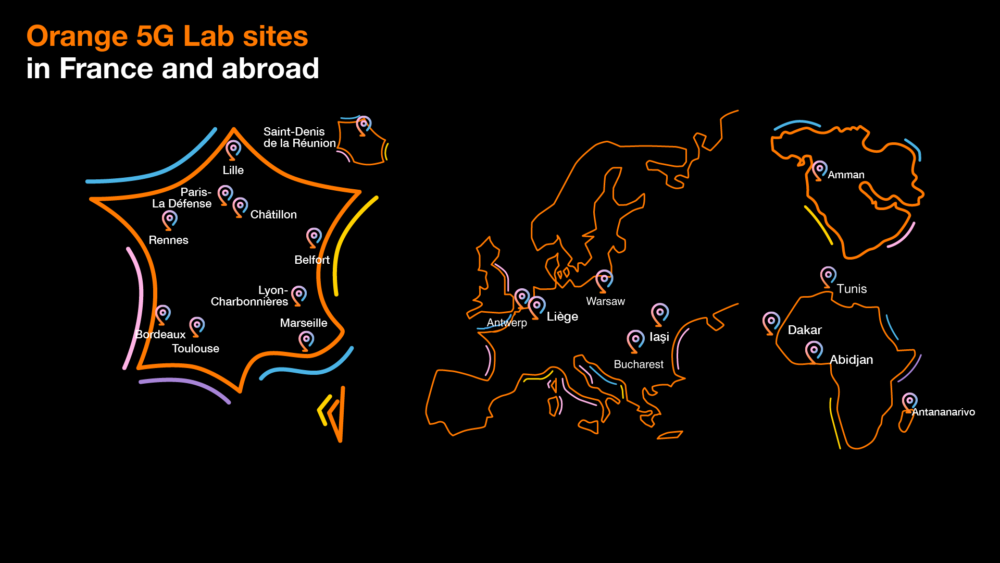
We are close to you in France and abroad
Orange 5G Lab is being rolled out in France and internationally with the opening of 20 spaces in several major cities in France, Europe, Africa and the Middle East. These are places created to receive companies, in the territories, as close as possible to their economic interests.
Come and meet our advisors